Home Up Home cultivation Small commercial cult. Commercial Cultivation Précis of Log Inoculation process Shitake on logs Shiitake on sawdust
 

Home
Up


Natural Log Shiitake Mushroom Production, Processing and Marketing

 Shiitake, comes from the Japanese  Shii, which means oak and take which means mushroom, it is the second largest cultivated mushroom species in the world, second only to the white button mushroom or champignon (Agaricus bisporus). This mushroom has been cultivated in China and Japan for hundreds of years,  a major upswing in  production occurred in the late 1940's after the development of modern cultivation techniques by the Japanese. The shiitake market in both fresh and dried format has grown to be a world wide multi-billion dollar industry, the bulk of which is still centered in the Orient with Japan and China being the largest producers and consumers. Shiitake, and other mushrooms, are a much more common staple in oriental households. The average consumer there is more aware of the excellent nutritional and medicinal properties of mushrooms and they are incorporated almost daily in their diets. North Americans on the other hand know little about mushrooms, in many cases have a slight fear of them or often hold the misconception that they have little or no nutritional value.  North America got a late start in shiitake mushroom cultivation mainly because of a mistake by the US Department of Agriculture. For a long period the USDA was under the mistaken belief that shiitake, or in Latin Lentinula edodes,  was a fungus that attacked railway ties ......, so they banned importation of the live cultures into the USA. In 1972 the mistake was realized and restrictions were lifted, since then production in the USA and Canada has steadily risen, shiitake are now fairly common on supermarket shelves of big cities and along with increased good press on exotic mushrooms, consumption of this food item is likely to steadily increase.

Production

Shiitake is cultivated in two ways, outdoors on natural hardwood logs or in a climate controlled building on artificial logs made of hardwood sawdust and various nutrients. The advantage of outdoor production is minimal capital investment,  the logs can be cut from your own bush lot or purchased locally, and since they are kept in the bush under a canopy of trees to fruit, there is no need of a building. Another advantage is that in general a better quality product is produced outdoors even though there is quality degradation if the mushrooms are soaked by heavy rains and there may be some possible pest loss due to slugs depending in your location. The disadvantage is seasonal production only, versus year round indoor cultivation, and  a somewhat heavier work load especially if you have large diameter logs.

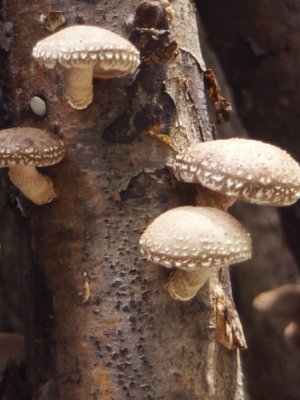
All mushrooms are actually the "fruits" or reproductive forms of various organisms classified as fungi, they are like the apples on a tree. The actual fungus  is a white strand like mass called mycelium, if you see a mushroom in your forest or lawn you will find the mycelium growing under the surface. Shiitake mycelium is a primary wood decomposer, it degrades the lignin and other components of wood and extracts the nutrients to feed itself. When it has gathered enough resources the mycelium will try and reproduce itself by producing mushrooms, which then release spores into the air. To cultivate this mushroom, mycelium is introduced into the logs in the form of a cloned culture called spawn.  The logs are then placed in an environment that is conducive to mycelial growth and when the mycelium has taken over the logs (about a year in our climate) we then stimulate them to fruit or wait for natural fruiting. By keeping our logs in the right environment such as under a bush canopy, the mycelium will continue to stay alive and degrade the wood until all the nutrients are gone, periodically producing mushrooms during this process. The average lifespan of an oak log is 1 year for every inch of diameter.  

To start with the logs must be freshly cut limb wood from a live tree, so there are no competitor fungi in the wood. Winter cut logs are recommended because there is a high concentration of sugars in the wood which will give the mycelium a kick start. Oak is the best hardwood to use, its tenacious bark will stay on the logs for years keeping the moisture inside and the competitors out. Reasonable success however has been achieved by using species such as ironwood, alder and birch but the longest and most fruitful production is achieved by using oak. Once cut the limb wood can be left frozen in the bush until spring ,but it should be cut into 4 ft. lengths and inoculated with the mycelium as soon  as the weather warms up. This is generally late April early May in Ontario. If a heated greenhouse or building  is available inoculations can begin earlier. The logs should range between 4" to 8" diameter, larger logs can be used but are very unwieldy.

Introduction of the mycelium into the logs is accomplished by drilling a series of evenly spaced  holes into the logs. A small quantity of mushroom spawn is placed into these holes and the holes are sealed. Spawn is available from various manufacturers, it comes in two forms, sawdust spawn and plug spawn. Sawdust spawn is mycelium growing through a sawdust mix, plug spawn is wooden dowels with the mycelium growing on them. In general sawdust spawn is cheaper and works faster than plug spawn, it is however more susceptible to drying out so the holes must be sealed properly. Sawdust spawn is injected into the holes using some form of inoculator, either manual or pneumatic, dowel plug spawn can be pushed in with your fingers. A new  type of sawdust spawn is sawdust plug spawn, which is sawdust formed into small plugs and is pushed into the holes with your finger.  After the spawn is in, the holes are sealed with molten cheese wax or in the case of pneumatic inoculators a small piece of Styrofoam is placed in the hole by the machine. Sawdust plug spawn has a styrofoam backing and is self-sealing.

The logs are then stacked in the shade of the bush and are monitored for moisture content, they should not be allowed to dry below 25% moisture content or the mycelium will die. Watering the logs once a week (unless there is plenty of rain) by setting up a sprinkler over the stacks is recommended for 3-4 months after inoculation. The sprinklers should be on for 3-4 hours to thoroughly soak the logs. Although this watering is not absolutely necessary, it has been shown to speed up the process and often results in some mushroom in autumn if inoculation is done in spring. The mycelium will colonize the whole log and by the following spring/summer mushrooms will start to pop out from the sides of the logs. At this time the logs are rearranged in the bush so that they are standing up, this is accomplished by stringing wire between trees or posts and leaning the logs alternatively on both sides. This allows the mushrooms to come out without touching the ground and allows easy picking from each log.

Once the mycelium has taken over the log completely, the trigger to produce mushrooms is moisture, heavy rains will stimulate the logs to produce. Rather than wait for rain however we can "force" the logs to produce by either soaking them in cold water for about 12 hours or by setting up a sprinkler system on them for 24- 48 hours. Soaking is the preferred method because the water has a chance to get right into the center of the log. Depending on the ambient temperature, mushrooms will start to form  in 1-2 weeks after watering and will be ready to pick in a few days after that. In the cooler spring or late fall weather, the mushrooms grow slowly  producing a dense fleshed product, this is considered  the best quality. Summer growth is much faster producing a thinner fleshed mushroom. Once the "flush" of mushrooms has been picked, the logs are left to rest for six to eight weeks and then can be watered again for another crop. Three to four flushes can be forced from April to December depending on geographical location. Farmers with heated greenhouses can bring the logs inside and produce during the winter as well.

 The average yearly production will be  1-2 lbs. per log  more if the logs are forced more often, however this will shorten the lifespan of the log. The total average yield from one log will be in the neighborhood of 8 lbs. with proper management techniques. Once all the nutrients in the log are used up you may still be able to get some heat from the logs..

Harvesting and Marketing

Shiitake are sold fresh as well as dried.

Fresh

Fresh mushrooms are picked when the veil over the gill breaks and should be refrigerated as soon as they are picked, a  temperature of 3 degree C will give them a shelf life of up to three weeks. The shelf life is considerably shortened if the mushrooms are soaking wet and they  should be sold as soon as possible. Currently the grading for acceptable quality fresh mushrooms  is  A and B grade; "A" being a good looking mushroom with the edges of the cap still turned in, B grade is mushrooms with the edges splayed out, and generally inferior to the top A grade. There is of course some percentage of the crop that is not sellable, so you generally start eating more mushrooms than you did before. This is not all bad as they are very good tasting (somewhat like meat); they are an excellent source of protein, minerals and some vitamins. Shiitake have polysaccharides in them that have anti- cancer effects and stimulate the immune system, so not only will you eat more mushrooms but you will eat them for longer. There is quite an interest developing in the alternative health community for mushroom extracts due to their medicinal effects, and this may lead to a possible use of the lower grades. The outdoor method of cultivation is almost de-facto organic if you keep the logs away from any sprayed fields. ORGANIC CERTIFICATION can help in the marketing considering the current interest in chemical free products. Vegetable wholesalers, local restaurants, farmers markets, supermarkets, gourmet and health food grocery stores are all possible marketing venues for the fresh product. 

The competition to log grown shiitake comes from indoor sawdust block growers. The quality of their product is generally much lower but they can offer it a lower price. The public, and often wholesale buyers are unaware of how the mushrooms are cultivated and the best quality they should look for. Often lowest price, rather than quality is the criteria  used for purchasing. This has a negative effect on the whole industry because the consumer, who is used to low costs for the white button mushrooms, is now asked to pay quite a lot more for these exotic mushrooms. Unless he is suitably impressed by the quality of the product, enough to warrant the extra cost, it is unlikely that there will be a repeat purchase. Fresh mushrooms are generally sold in 3 lb. Boxes. The current price  growers are getting from wholesalers is $ 5-6  per lb. for A, and $3-5 for B grade. 

If you plan to market your mushrooms into an established market such as Toronto and are new at this you should consider marketing through another long established grower. You may get a less for your product but it might save headaches in trying to sell your mushrooms. Developing your own sales contact such as CSA groups, farmer’s markets, your local supermarket etc. will increase your profits. If you are selling directly to the above mentioned groups you should charge either a wholesale price, which is generally up to 30% above farmer price, or retail price if selling to the public.

Dried

Gluts in the fresh shiitake market occur periodically but fortunately shiitake can be easily dried, as a matter of fact world wide the bulk of shiitake is consumed  from reconstituted dried mushrooms. If the mushrooms are dried to about twelve percent moisture content, sealed in plastic, they can keep practically forever. Care should be taken that they do not get moist as they may mold. The ratio of fresh to dry is approximately 7 to 1. At the moment the North American market for dried shiitake is very competitive due to cheap imports from China, the quality of these imports is very low but consumer ignorance of mushrooms in general makes marketing a higher quality and priced product a struggle.  The same CSA groups, Farmer’s markets etc. should still be available avenues for marketing. Alternatively, value added products such as homemade soups, sauces etc. can be marketed.

Japan is one of the largest producer of shiitake but it is also the largest consumer and importer. The Japanese grading system for dried shiitake involves about a dozen grades, the best grades are attractively packaged and used as gift items. Japanese production  has declined in the last 10 years due to an ageing farming population not being replaced by younger farmers and by declining oak log resources. Although they have a program to  plant and harvest oak trees for shiitake logs,  with an average 15 year span between planting and logging , theirs  still is a declining resource.  Currently more and more Chinese and Korean imports are finding their way into their markets. The Chinese imports are mostly cheap, low quality grades, used for processing. The Korean products are of better quality but are more expensive. My opinion is that we would have success marketing our better grades to the Japanese market,  buyers have already shown interest in our production and they are looking for container loads of dried shiitake. Unfortunately our  current  production is not sufficient to fill these orders on a consistent basis. We are currently trying to co-ordinate a sales effort to smaller wholesalers and to retailers who are willing to start with smaller orders. I believe that outdoor log production, which makes use of a resource which is currently either left in the bush or used as firewood after tree logging, could give farmers and woodlot owners an added income from their bush, while promoting the reforestation of land as the demand for oak logs increases.

For More Information Contact:

Mycosource Inc.
R.R. 1, Goodwood ON, Canada L0C 1A0
Tel: 416-402-9755
FAX: 416-963-5520
Internet: office@mycosource.com